
About Cycling
- Main page
- About Cycling
History of Cycling
Bicycle – (from French vélocipède, meaning “fast foot”) is most often a two-wheeled vehicle powered by pedaling. Movement on a bicycle is made possible through stabilizing propulsion, accompanied by high speed, steering control, and adjustment of the center of gravity. After the sewing machine, the bicycle is considered the second technical product in the world to be mass-produced and widely distributed. Its small size, affordable price, and lack of need for fuel are among the main reasons for its widespread use worldwide.
The history of the bicycle in the world begins about 500 years ago, when Leonardo da Vinci depicted a design resembling a bicycle.
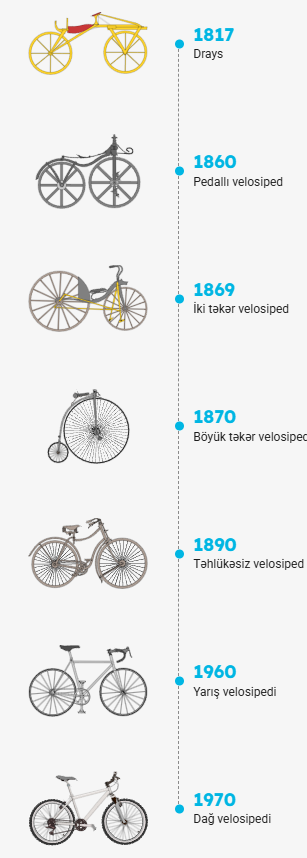
According to some accounts, the invention of the bicycle in 1816 was stimulated by a volcanic eruption that killed horses, creating a need for alternative means of transportation. The first bicycles looked completely different from modern bicycles. The first bicycle was invented in 1817 by Baron von Drais, who lived in Mannheim, Germany. This was a steerable bicycle, made almost entirely of wood, but it did not have pedals. Its first model was propelled by pushing the feet against the ground to move down sloped streets. The top speed of these early bicycles did not exceed 15 km/h. Despite this, the early bicycles had yet to gain widespread popularity because the first invention lacked two important elements. One of them—the pedals—was first added to the front wheel in 1861 and later, in 1888, attached to the rear wheel via a chain to drive it. By 1842, when the idea of fitting rubber tires onto bicycle wheels emerged, bicycles had already begun to take on their modern appearance.
The first bicycle race in the world was held in 1819 in Sweden. In Germany, a similar race took place in 1829. Later, bicycle races began to be organized in most European countries. Since 1893, world, European, and other international cycling competitions have been held. Bicycle racing was also included in the program of the first Olympic Games. Cycling as a sport includes disciplines such as road cycling, track cycling, mountain biking (MTB), and BMX (bicycle motocross). In 1900, in Paris, the cycling organizations of Belgium, the USA, France, Italy, and Switzerland founded the Union Cycliste Internationale (UCI). The UCI organizes international-level cycling competitions. Its headquarters are located in Geneva, and the working language is French. The International Cycling Union consists of two international federations: one for Amateur Cycling and one for Professional Cycling. Its supreme body, the Congress, meets three times a year to discuss current issues, membership, race calendars, and other matters. Currently, the most prestigious road cycling races in the world are considered to be the Tour de France in France, the Vuelta in Spain, and the Giro d’Italia in Italy.


History of Cycling in Azerbaijan
The history of cycling in Azerbaijan began in the 1920s. During that period, bicycles started to be used as a means of transportation in the country. These bicycles were imported from Russia. Initially, bicycles were more popular among schoolchildren and students, which is why they were also used in inter-school and university competitions. The organization of larger-scale bicycle races in Azerbaijan dates back to the early 1940s. By that time, Spartakiads among cyclists within the republic had already begun. Like in Europe, these Spartakiads were held once every four years. Azerbaijani cyclists used bicycles manufactured at the Kharkiv factory in Ukraine for these tournaments.
Sabzali Huseynov and Huseyn Zargarli were among the first representatives of cycling in Azerbaijan. They later continued their careers as coaches. The bicycles used in races at that time could reach speeds of 30–35 km/h. To train professional cyclists in Azerbaijan, both local and foreign coaches were involved. Notable names include Huseyn Zargarli, Sabzali Museyibov, Sergey Romanov, and others. Huseyn Zargarli, who also participated in international competitions, was recognized as a referee of all-Union level.
Starting from the late 1940s, not only men but also women began participating in bicycle races in Azerbaijan. Initially, Azerbaijani cyclists who proved themselves in local Spartakiads would qualify for the Republican Spartakiad after winning. The Baku teams, composed of both men and women, would win at local Spartakiads and go on to participate in the All-Union and Transcaucasian Spartakiads.
Starting from the 1950s, significant progress began to be made in cycling in Azerbaijan. Azerbaijani athletes were already testing their skills in USSR championships and world championships. During that period, athletes such as Alkhas Talibov, Aladdin Shabanov, Vladimir Davidov, Ramiz Rahimov, Viktor Semergey, Alexander Averin, and others participated successfully in competitions. Alkhas Talibov and Aladdin Shabanov were awarded medals, diplomas, and certificates of appreciation for their achievements in tournaments held in Europe. Aladdin Shabanov represented Azerbaijan at a high level in more than 50 national cycling competitions, as well as in world and European championships and super cycling marathons.
In 1980, by the decree of the National Leader Heydar Aliyev, the Republican Velodrome was built in Baku according to world-class standards and put into operation. This velodrome, with a length of 333 meters, hosted a number of All-Union competitions. In 1985, a delegation of Azerbaijani cyclists participated in a conference held in Moscow, where the country’s cyclists were awarded various diplomas. Starting from the 1990s, systematic cycling tournaments began to be organized in Azerbaijan. Azerbaijani cyclists consistently took part in the Baku and Azerbaijan championships. During this period, the speed of bicycles in competitions increased to 40 km/h.
In 1991, as part of the grand celebrations dedicated to the 850th anniversary of the great Azerbaijani poet Nizami Ganjavi, a 4,000 km cycling tour was organized along the Saint Petersburg–Ganja route. Cyclists from Azerbaijan participated successfully in this tour, which included representatives from 26 cities.
After Azerbaijan gained independence, there was a significant revival in all areas of the country, including sports policy. In 1992, the National Olympic Committee of Azerbaijan was established, and in 1996, Azerbaijan participated in the Summer Olympic Games for the first time as an independent state.
After Ilham Aliyev was elected the President of the National Olympic Committee in 1997, the Olympic Movement in Azerbaijan began to develop rapidly. Thanks to his efforts and initiative, the organizational and structural work of the National Olympic Committee progressed successfully in a short period. Modern sports complexes were built and made available to athletes, and independent sports federations, including the Azerbaijan Cycling Federation, were established.